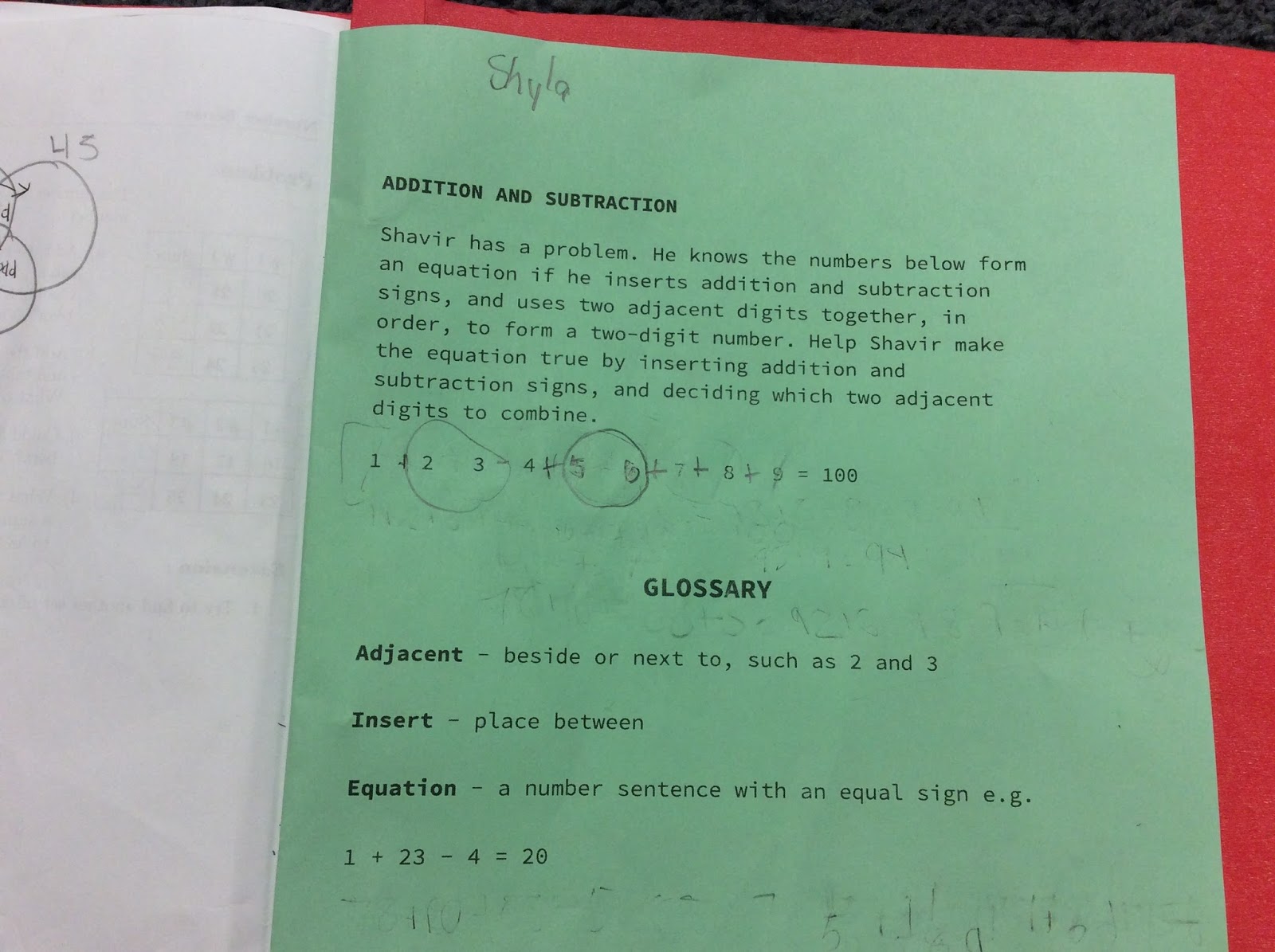
This Math problem had us thinking deeply about numbers. Specifically adding consecutive numbers. We made some interesting discoveries:
- the sum of two consecutive numbers will always results in an odd number
E.g. (2 + 3 = 5 ) 5 is an odd number, 2 and 3 follow each other. They are consecutive numbers. Try some more on your own to prove this theory!
- the sum of three consecutive numbers always results in a number that is divisible by 3
E.g. (4 + 5 + 6 = 15) 15 is divisible by 3.
Here's another discovery - you can simply multiply the middle number times 3 to find the total. In the example, 5 is the middle number. Multiply 5 X 3 and voila! The answer is 15. This works for any three consecutive numbers
Math is awesome, right?
More Discoveries
58 cannot be the sum of 5 or 6 consecutive numbers. It can, however, be the sum of 4 consecutive numbers 13 + 14 + 15 + 16 = 58
Students' Responses to question