Thursday, 8 June 2017

How many nets for a cube?

Review of number of edges, vertices and faces for 3D shapes. Great interactive website at:


Minds On: Visualising 
This act of visualising the folding of a net is one of the essential reasons for working with them, and is far more important mathematically than simply constructing solids from their nets.


Main task: Students were not shown the sketches below while they worked on the task. They had to independently figure out the number of nets by using Polydrons to make possible nets for a cube. Some students were convinced there were 10, 11 or 12 possible nets. The correct answer? There are 11 nets for a cube.


Monday, 5 June 2017

Faces, Vertices and Edges of Pyramids and Prisms


Some of my kiddies figured out Euler's Formula on their own! Way to go smartians!

For any polyhedron that doesn't intersect itself, the number of faces, plus the number of vertices (corner points), minus the number of edges always equal to 2.

F + V - E = 2

They also made other interesting observations. In order to calculate the number of faces, edges and vertices of prisms they noticed:

Number of sides + 2 (will figure out the number of faces)
Number of sides x 3 (number of edges)
Number of sides x 2 ( number of vertices)

For Pyramids:

Number of sides on base + 1 (tells the number of faces)
Number of sides on base  x 2 (number of edges)
Number of vertices and number of faces are the same.

Excellent observations kiddies!


Friday, 2 June 2017

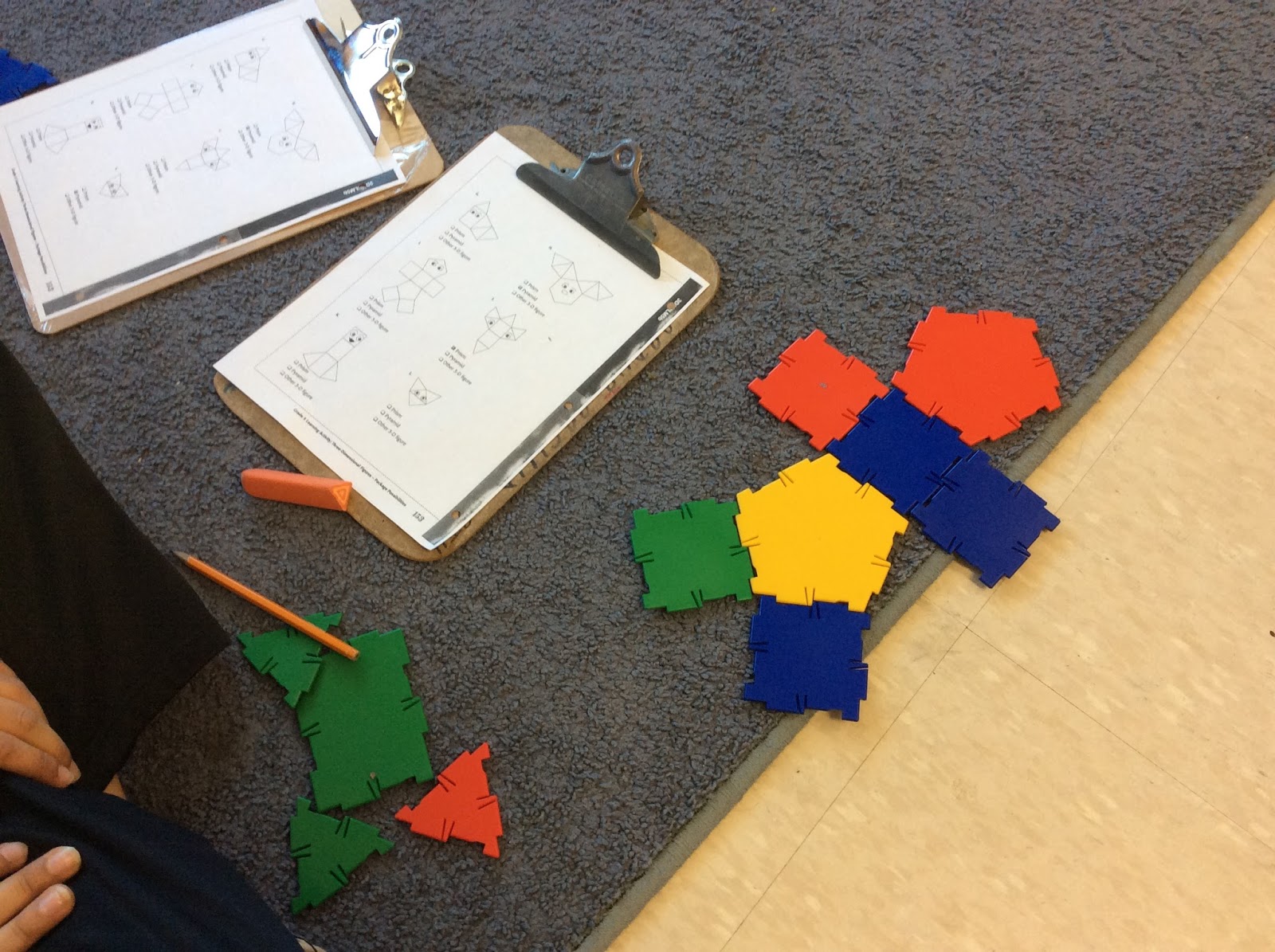
Prisms, Pyramids or other 3D shape?


Yes, this is a pyramid! It's an oblique pyramid. It is a pyramid with an apex that is not aligned above the center of the base.


Thursday, 25 May 2017

Geometry - 3D Shapes


Sketching our nets on isometric dot paper


If we assume that two nets are equivalent if one can be rotated or flipped to overlap with the other one, there are six possible nets for a square pyramid.